Lifetimes of Demolished Buildings in US and European Cities
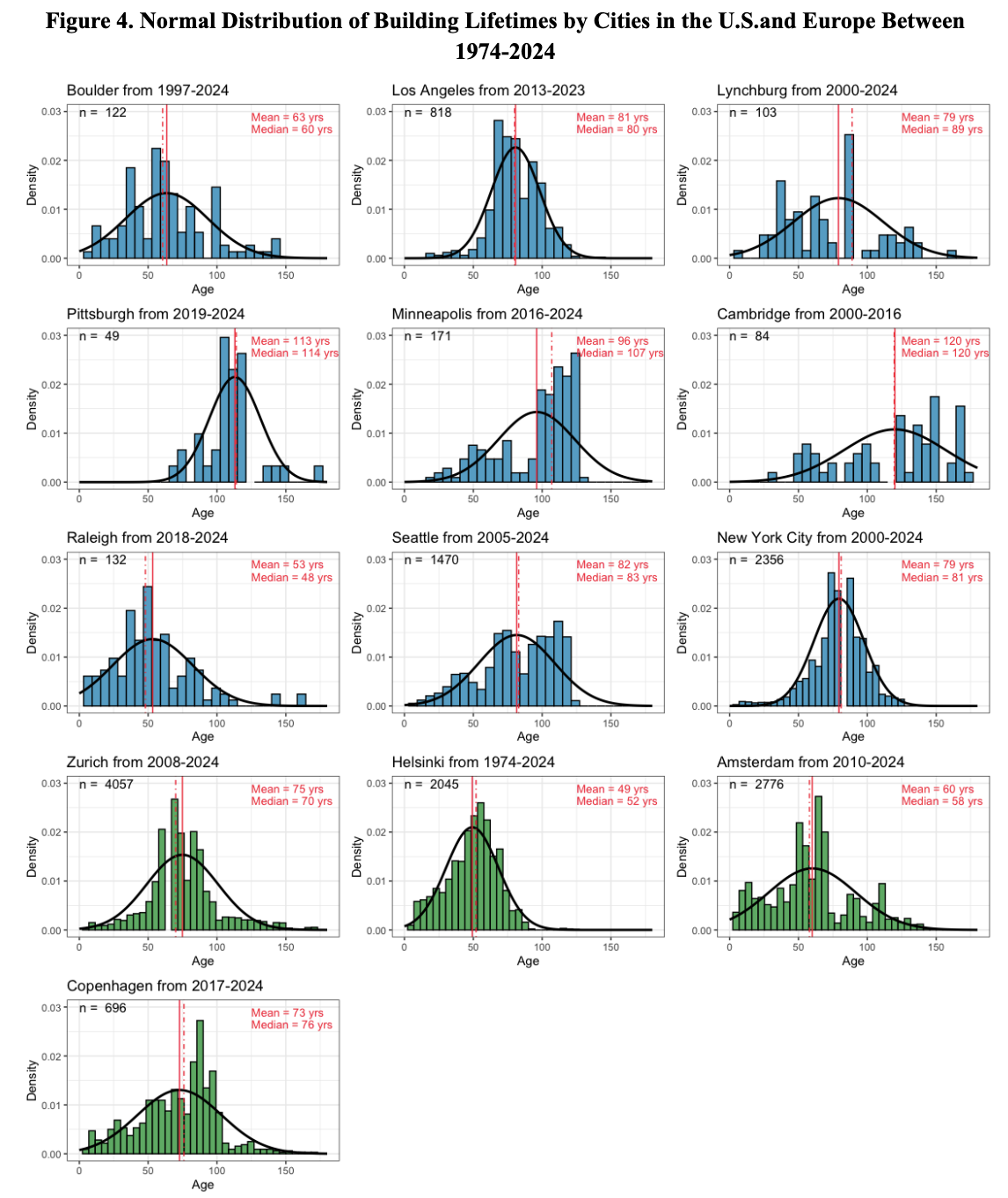
Building lifetime is a useful metric that serves as an input for many analyses, including property valuation, life-cycle assessment, material flow analysis and building stock analysis. Additionally, building lifetime is essential for the adoption of circular economy principles and retrofitting in construction, which ultimately will help reduce greenhouse gas emissions in the built environment. Yet, limited end-of-life building data and a focus on the design lifetimes of buildings means estimates for actual building lifetimes are outdated, not empirically based or else not compared across regions. By first sourcing and cleaning an extensive dataset of approximately 15,000 demolished buildings, in this project we conducted a statistical analysis to: empirically estimate average building lifetimes in nine US and four European cities; analyse trends in building lifetimes across a number of design variables; and understand building obsolescence by applying techniques from survival analysis to buildings. An average lifetime of 71 years was found across all buildings, with a standard deviation of 28. Significant differences in lifetimes of use types were identified, with residential buildings lasting the longest. Age of the city did not appear to influence the survivorship of demolished buildings, but current and past demolition trends could.
J. Berglund-Brown, I. Dobie, J. Hewitt, and J. Ochsendorf, “Lifetimes of Demolished Buildings in U.S. and European Cities,” Buildings and Cities, in proofs.
This paper is the first to assess building lifetimes of all building types based on empirical data across U.S. cities and is the first to compare U.S. building lifetimes to those of European cities.
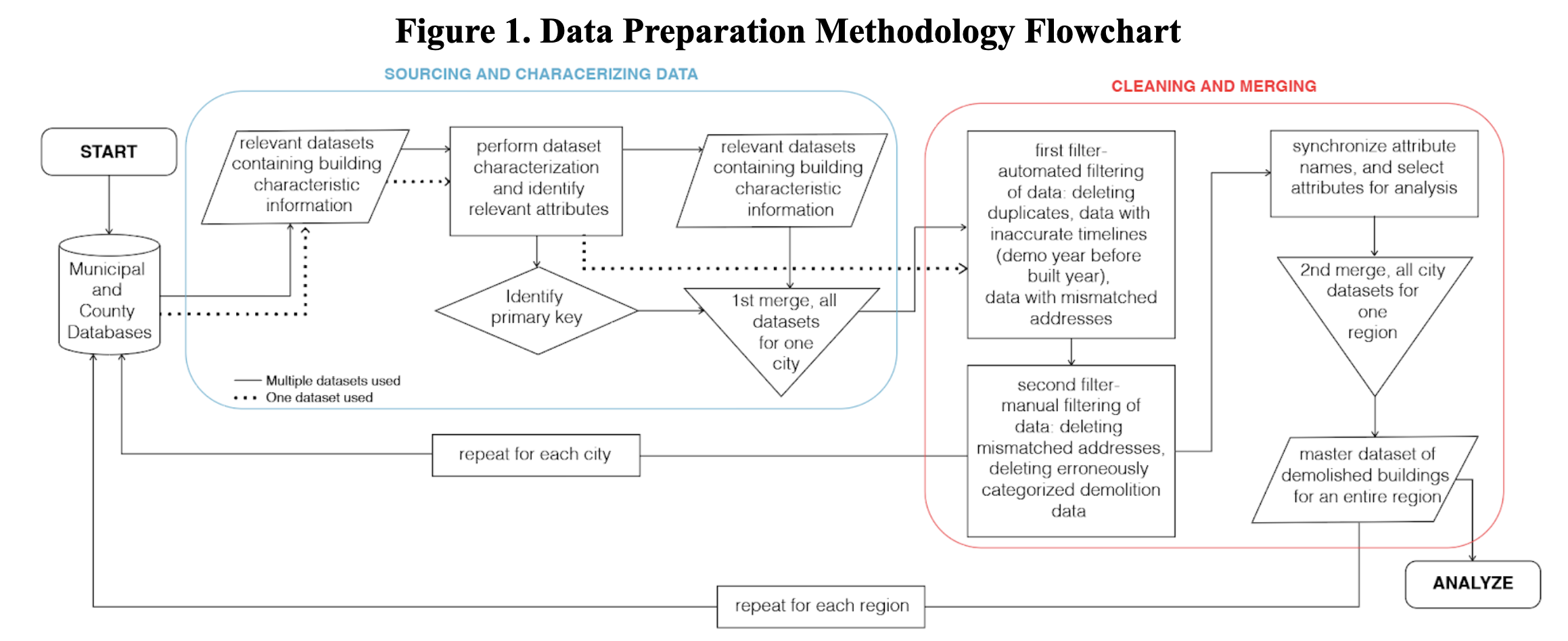
The data in this paper originates from 13 cities across several states and countries, and was collated in an iterative process, cleaned, and analyzed using processes detailed in the figure below.